How to replace home air filters
How to replace home air filters

Key takeaways
The right filter will improve your home’s air quality
You’ll need to change the air filter on a regular basis
Installing a new filter is easy, if you avoid some common mistakes
The heating and cooling systems that keep our homes comfortably cozy year-round are remarkably reliable, and generally require little maintenance. In most cases, there are just two things you must do to keep equipment operating at peak efficiency: First, get the system inspected annually by a professional HVAC (heating, ventilation, air conditioning) technician, and second, change the air filter on a regular basis.
Whether you have a complete HVAC unit or a separate forced-air furnace or air conditioner, changing the air filter regularly is extremely important. A clogged, damaged, or ill-fitting filter can cause all sorts of problems—ranging from dirty, polluted indoor air to restricted airflow in the unit itself, which puts undue strain on the blower motor. Air quality issues—such as smoke from wildfires—can also tax your HVAC, and how well the system filters out harmful particles.
“When you [understand] that the air in your house passes through the filter two to three times per hour, you realize just how important the air filter is for the health of your indoor air and HVAC system,” says remodeling contractor Danny Lipford, host of the syndicated TV show “Today’s Homeowner.” That’s why it’s critical to buy the best filter for your HVAC system and change it regularly.
In this article, you’ll learn how filters are rated for efficiency, how to choose the best one for your system and home, and how to change the filter in your unit.
Air filter ratings
Most filter brands and styles come in a wide range of efficiency ratings—that is, how well they remove dust and smaller particles from the air. The better a filter is at blocking the tiniest particulates, the more expensive it’s likely to be.
The choice of filter will depend on what’s recommended for your forced-air heating and air-conditioning system (if you don’t know, ask your HVAC technician), as well as your personal concerns about indoor air quality.
You’ll find that some filters use different rating systems than others, which can be confusing. Here’s how to understand each one.
Air filter rating system: MERV

Developed by the American Society of Heating, Refrigerating, and Air Conditioning Engineers (ASHRAE), MERV stands for Minimum Efficiency Reporting Value, and is the only nationally regulated rating. It uses a scale of 1–20 to rate efficiency; the higher the number, the finer the filtration. A MERV rating of 6–13 offers a good balance between air filtration and airflow, and meets or exceeds the needs of most households.
Here’s what the different MERV numbers represent:
MERV 1–4. Blocks large particles over 10 microns in size. (One micron equals one-millionth of a meter; for reference, a human hair is about 75 microns in diameter). Typically used for residential window AC units, this rating provides minimal filtration for pollen, dust mites, and carpet fibers.
MERV 6–8. Blocks smaller dust particles and lint; this is fine for homes with just one or two people and no pets.
MERV 9–12. Blocks very fine dust particles, pet dander, pollen, smoke, and even mold spores; these filters are recommended for people with allergies and other respiratory ailments.
MERV 13–14. Traps particles as small as 0.3 microns, including many types of bacteria and some viruses. These filters are recommended for people with compromised immune systems and those sensitive to infections.
MERV 15–20. These filters are typically reserved for industrial settings.

Pro tip: If you live in an area affected by wildfires, upgrade to an activated charcoal filter (also known as activated carbon filter) with a MERV rating of 13 or higher, to filter out smoke and ash particulates. Keep extra filters on hand, and change them weekly during periods of the heaviest smoke.
Air filter rating system: MPR
The 3M company developed the Microparticle Performance Rating (MPR) system to show how well its filters capture tiny airborne particles (smaller than one micron). The higher the number, on a scale of 300–1,900, the more particulates the filter will pull from air passing through. A mid-level filter would have an MPR rating of 1,000, which is roughly equivalent to MERV 11.
Air filter rating system: FPR
The Filter Performance Rating (FPR) is another rating system used by certain retailers and brands, based on a scale of 4–10. A mid-level filter would have an FPR rating of 7, which is roughly equivalent to MERV 11.
Another filter standard: HEPA
A high-efficiency particulate air (HEPA) filter is very effective at removing small particles, because it conforms to a particular high standard defined by the US Department of Energy (DOE). Often used in portable air cleaners, these filters remove up to 99.97% of fine dust, mold, pollen, bacteria, and particulates as small as 0.3 microns. But they aren’t recommended for HVAC systems, because they’re so efficient that they would greatly restrict airflow.
If someone in your household has allergies or other health problems, you may also choose to run a HEPA-filtered air cleaner—since most HVAC systems aren’t meant to be used all the time or remove all particles from the air.
Types of air filters
When selecting an air filter, the most important rule is to follow the recommendations for your system. Check the product information (or ask your HVAC technician) if you don’t know. You’ll also have some choice as to effectiveness and cost.
While most filters are disposable, some can be cleaned and reused, which can save money (and help the environment) over time.
Fiberglass filters

The simplest filter type, fiberglass has an inch-thick disposable cardboard frame and spun-fiberglass core. Starting at less than $2 each, fiberglass filters are very affordable. But they only filter out the largest dust particles and offer the bare minimum protection from dirty air.
Pleated filters
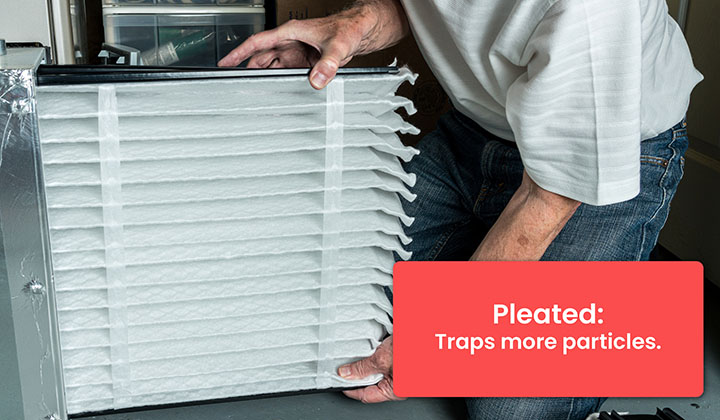
Providing better filtration than fiberglass, pleated filters are also disposable but last longer. They feature durable polyester or cotton folds (pleats) that increase the surface area, allowing the filter to trap more and finer particles.
Pleated filters come in thicknesses ranging from 1–5 inches; the thicker the filter, the better it cleans the air. A 1-inch-thick pleated air filter costs about $5–20, depending on brand and efficiency rating.
Pro tip: A thicker or higher-rated filter will clean the air more effectively, but some can also cause your fan to work harder as it moves air through. Check with your HVAC contractor to ensure it won’t affect the longevity of your heating and air-conditioning system.
Many units can only fit filters of a certain thickness. If you really want a thicker one, existing ductwork might need to be altered before the filter can be installed.
Electrostatic air filters

Electromagnetically charged to attract and trap small airborne particulates, these filters also catch dust and allergens. Most electrostatic furnace filters must be replaced at regular intervals, because dust buildup prevents the electromagnetic charge from working—but you can also buy ones that are washable and reusable. The downside is that standard-size electrostatic filters are more expensive, and generally cost $40–80.
Nanofiber air filters
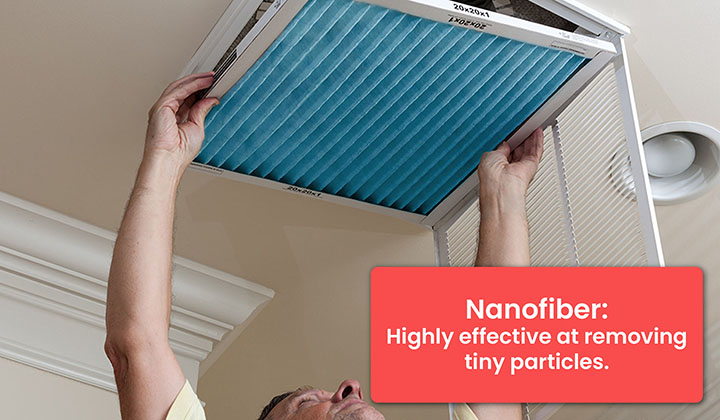
Not as well known as the others, nanofiber filters are highly effective at removing particles as small as 0.03 microns. Some are washable and reusable. Manufacturers claim high-quality nanofiber filters trap contaminants such as bacteria, viruses, dust mites, smoke, and ultra-fine pollutants, without reducing airflow. These filters range from about $30 to $50.
Whole-house electronic air purifiers

These devices take filter replacement the next step, providing a higher level of clean indoor air. This is a separate piece of equipment that connects directly to your existing HVAC system. Once installed, the electronic purifier will remove up to 99% of all dust and allergens. It may come with a specialized filter, which will need to be cleaned or replaced at certain intervals. Prices vary widely, based on size and capacity, but they typically start at around $400.
Pro tip: To help any home air filter last longer, vacuum at least one per week to remove dust, dirt, pet hair, and other matter that would otherwise be sucked through the system.
How to change your air filter

Changing an air filter is fast and simple. For most forced-air systems, all you need to do is pull out the old filter and slide in the new one. But it’s important to do this correctly—and it’s done wrong all the time.
Here’s what you should know:
Turn off the HVAC system via the thermostat.
Install correct size replacement filter. There are lots of different filter sizes, so it’s easy to buy the wrong one. A filter that’s even a little bit too small will allow unfiltered air to slip past and blow into your home. If you’re not sure, check the numbers printed on the old filter.
Install filter in the correct direction. If installed backwards, it will block the flow of air and put more strain on the blower motor. Most filters have an arrow printed on them to indicate the direction of airflow. If you have trouble remembering the correct way to install the filter, use an indelible marker to draw an arrow on the side of the furnace.
Remove and discard old filter. Replace it with a new one. If you have a washable, reusable filter, clean it according to the manufacturer’s recommendations—most can be machine-washed. Dry it, then slide the filter back into place. Most washable filters can be laundered 30–50 times before they need to be replaced.
Vacuum the area. When changing the air filter, use a vacuum to clean the area behind the filter opening, recommends Danny Lipford. That way, you’ll collect any dust buildup, and prevent it from blowing through the ducts and into your home.
Replace cover and record date. After sliding the new filter into place, replace any cover that goes over it, then keep a record of the date so that you’ll know when it’s time to change it again.
How often should I change my air filter?

To keep indoor air clean and HVAC system working well, change the filter regularly. Frequency depends on:
Type of filter (higher-efficiency models should be changed more frequently)
How often the HVAC system runs
Size of your home and household
Whether or not you have pets
Depending on filter type, you may need to change it monthly, or every 3–6 months. Read your HVAC instructions, or the package directions that came with the filter. Your best bet is to check with your HVAC technician, who can provide the most accurate recommendation for your system and home.

Find a heating, air conditioning, and HVAC technician in your area.
Find a good HVAC technician
Tell us about your air quality issues and we’ll connect you with trusted local pros.