How to Build a Catio (Cat Patio)
How to Build a Catio (Cat Patio)
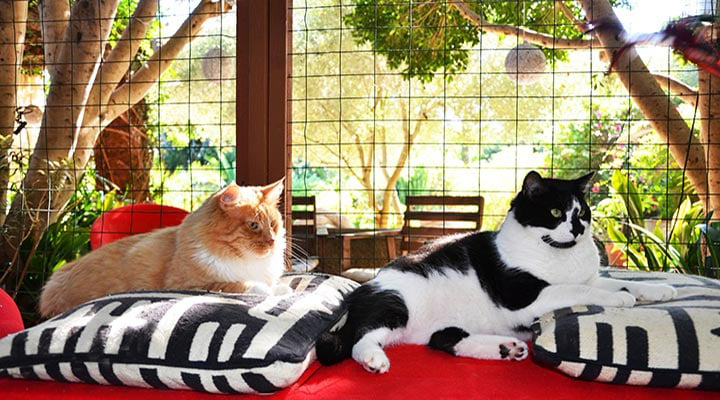
Learn how to create the purr-fect outdoor space for your indoor cat
If you have an indoor cat who longs for the great outdoors—or an outdoor cat you want to keep safe from predators—adding a catio to your house or apartment may be the purr-fect solution. “Cat patios” allow your feline friends to enjoy sunshine, fresh air, and the sights and sounds of the world around them, while staying fully protected.
Catios are outdoor spaces enclosed in galvanized wire that allow fresh air and sunshine in while providing an escape-proof barrier. They range from small, window-box catios to “cat mansions”—extravagant freestanding catio structures for the upscale feline.
“When it comes to catio designs, the options are endless.“
— Cynthia Chomos, founder of Catio Spaces, Seattle
If you want something basic, and you’re skilled in DIY projects, you can build your own structure using free catio plans. If you want something grander for your furry friend, you can have an outdoor cat house built by a pro. Some cat owners are going all-out these days, with big, creative catios complete with cat trees, cat tunnels, and other add-ons.
Ready to create the perfect catio? Here’s how to get started.
Design your catio

A builder and contractor, Cynthia Chomos first transformed her own patio into an enclosed space for her indoor cat, Serena. They both enjoyed it so much that she built 3 more catios onto her home, and made it a professional specialty.
“I had a flash of insight to combine my expertise as a designer and contractor to create visually appealing catios that complement different homes and gardens,” Cynthia says.
Here are some of her best catio-building tips:
Pick a sunny location. Cats are sun lovers, so—if you have outdoor areas to choose from—choose one with partial sun exposure and stimulating views. That might be a window box, patio space, porch or balcony, or maybe a spot in your garden.
Decide how your cat will enter the catio. If the structure will be attached to your home, plan to install a cat door in a window, wall, or standard door for easy cat access. If the structure will be farther away from the house, you can build a fun tabby tunnel from your home. And if you want to join your cat in a large catio, plan a second, larger door that allows human access.

Determine the catio size. Based on your space, figure out the approximate size you can accommodate. And don’t forget—even in a small home, you can always build upward as high as possible. Your perch-loving kitty will thank you.
You may need approvals
You might need written approval if you’re a renter, or if you have a homeowners or condo association. Also, check with your city to see if a permit is required for the catio size you have in mind.
If you need to dig when building your catio, call 811 to place a utility-line locator request. Someone will mark your yard with paint or flags so you don’t accidentally hit a utility line.
DIY your own catio

If you’re a do-it-yourselfer with basic carpentry skills, you can build a catio in just a weekend, according to Cynthia. In addition to building materials, you’ll need a few essential tools to get started, including a circular or chop saw, wire cutters, and a heavy-duty staple gun.
You can find DIY catio plans online, or purchase one of Cynthia’s, with step-by-step instructions. Her designs include the Window Box (a compact, veranda-style catio that can be built off a slider or sash window), the Haven (a multilevel, 3-sided catio for a patio or deck), the Sanctuary (a multilevel, 3-sided catio with space for human seating), and the Oasis & Tunnel (a stand-alone catio with space for human seating and a tunnel for your cat to get there from a cat door).
Hire a catio pro

If you prefer to have a catio built for you, hire a professional. A good handyperson can build a simple catio, but you’ll need an experienced building contractor for something more complex.
While researching your options, look for a contractor who:
Is licensed and bonded
Has experience building outdoor structures
Adheres to local building codes
Has positive reviews on Yelp
Can provide client referrals
Cynthia suggests finding out if your contractor has built catios before, and asking for photos of previous outdoor projects. “It’s a bonus if your contractor is an animal lover,” she says.
The contractor should know which permits are required in your area, and may handle the applications—but you’ll still be responsible for any fees.
Keep safety in mind

Whether you’re DIYing or hiring a pro, it’s important to take safety precautions for both you and your cat. They include:
Avoid blocking a bedroom window or emergency exit, unless you build a human door for your catio.
Keep household doors closed during building so your cat doesn’t get out.
Create a level and stable foundation.
Make sure your cat can’t slip out of the catio, but also that it can’t be breached by predatory animals.
Avoid protruding screws, sharp wire, and loose knot holes on shelves.
Don’t use vinyl-coated wire or artificial grass, which can be choking hazards.
At the end of the project, make sure no sharp metal objects have been left behind. You can find them by swiping the area with a construction magnet (available in home-improvement centers and online).
Enjoy your new catio

All that’s left is for your furry friend to luxuriate in fresh air and sunlight. If you want to accessorize, add a cat tree, interesting floor textures, a cat bed, scratching posts, and other items your cat loves.
Find a handyperson or building contractor in your area.
Featured image: Custom Catios, Los Angeles.