Home composting made easy
Home composting made easy

Key takeaways
Composting can lower your monthly garbage bill by reducing the amount of food waste you place in the trash can
Adding finished compost to your garden is a free and natural alternative to expensive fertilizers containing synthetic chemicals
Composting helps the environment by keeping food scraps and other organic material out of landfills
Looking for a simple way to live a more environmentally friendly lifestyle? Home composting—the practice of recycling food scraps for fertilizer—may be the answer.
Food waste currently accounts for 30% of what we throw away each year. When vegetable scraps, banana peels, and other organic matter decay in landfills, they emit methane, a greenhouse gas that contributes to global warming. But you can prevent that just by tossing your kitchen waste into a composting bin rather than the garbage can.
Composting not only keeps the remains of your breakfast or dinner out of trash dumps, it turns them into a nutrient-rich food that can be used for home gardens and general agriculture. It’s also a cheap way to make fertilizer during the current worldwide shortage.
Sounds great in theory, right? Yet many people consider composting an “icky” job that smells up the kitchen and attracts pesky critters. And because decomposed organic waste can have health risks, proper handling is essential.
New zero-waste laws, however, are encouraging reluctant consumers to hold their noses and level up their composting chops. In January 2022, California became the first state to require residents and businesses to compost food scraps and yard waste. Composting-friendly cities like Denver, Seattle, and Portland, Oregon have long-running voluntary programs. To find out about your own state’s food-waste prevention efforts, consult this guide compiled by the US Environmental Protection Agency (EPA).
Whether or not composting is eventually required in your area, it’s important to know how to handle food scraps responsibly. And you don’t have to be an expert gardener or farmer to do so.
This home composting guide explains what you can—and can’t— compost, where to collect scraps, and what to do with finished compost. Don’t want the mess? Learn about composting services that’ll do the dirty work for you.
What is home composting?
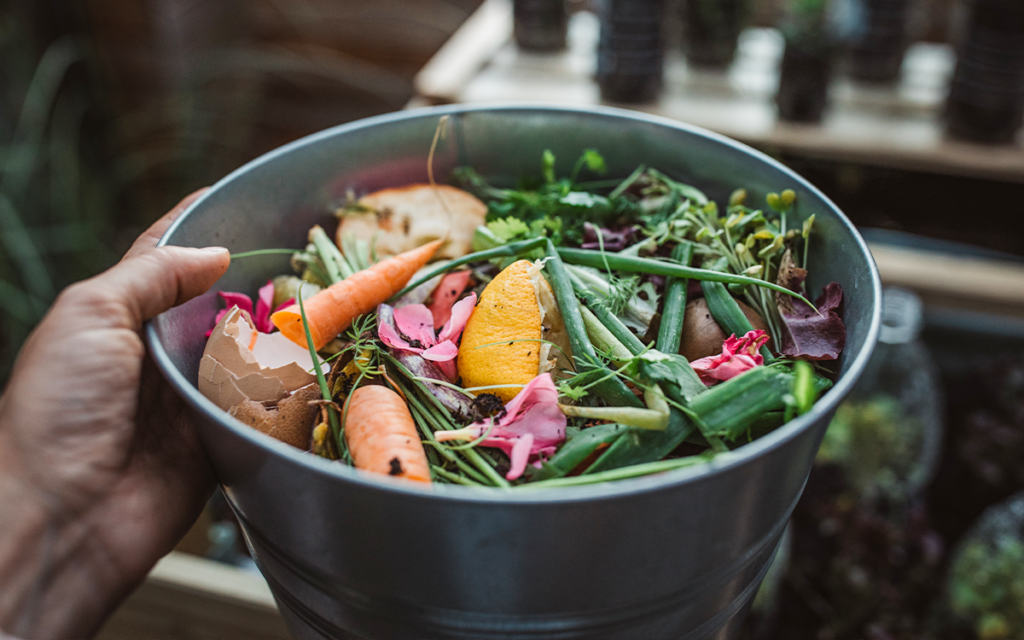
Home composting is the process of collecting food scraps and yard waste into an indoor or outdoor composting bin, where it’ll decompose into a soil-like substance that’s rich in beneficial microorganisms. The finished compost—which farmers refer to as “black gold”—can be used for potting plants, mulch in your garden, and other agricultural purposes.
While composting methods vary, the basic recipe is the same. Good compost requires a mix of ingredients: “greens,” “browns,” and water. A ratio of 3–4 parts brown to 1 part green is the general recommendation.
Fruits, vegetables, grass clippings, grains, eggshells, and coffee grounds—all organic substances rich in nitrogen or protein—are considered “green material.” Twigs, wood chips, dead leaves, and paper— all dry or woody plant materials rich in carbon or carbohydrates—are referred to as “brown material.” Water helps speeds up decomposition of the organic matter.
What can’t be composted: Oils, grease, and fat, as well as dairy products, raw meat, plastics, and metal. Some of these substances emit strong odors or attract pests while decomposing. Same goes for pet waste and chemically treated yard trimmings, which can contain harmful parasites or pesticides that kill beneficial composting microbes. The EPA provides a full list of what can and cannot be composted.
It takes a few months to a few years for waste to be transformed into compost, depending on how much time you invest in maintaining it. The process is complete when your pile yields dark brown, earthy-smelling, soil-like particles.
If you’d rather leave the actual composting to someone else, you can deposit food scraps in a plastic bin that’s picked up weekly by your waste-management company (or a private service in areas that don’t have composting programs). In return, these programs often offer free compost to residents once or twice a year.
Next step: Deciding whether to compost indoors or outside.
Indoor composting

If you live in an apartment or lack outdoor space, you can still compost kitchen waste. In fact, indoor composting is a popular practice that’s as simple as collecting food scraps in a countertop bin.
There are 2 types of indoor composting methods:
Scrap collection only. If you just want to reduce food waste, place your scraps in a countertop container. When it’s full, empty the waste into an outside compost bin, to be picked up weekly by your waste-management company. You can also drop it off at a compost collection location.
Making finished compost. If you want to make compost for your garden—and are willing to spend a few dollars—buy an electric composter (about $300–700 at some home-improvement stores and online), which dries and grinds up food waste quickly. You deposit food scraps into the container, push a button, and voila! In about 20–24 hours, you’ll have nutrient-rich dirt to feed your plants. (Compost times vary by manufacturer. See “Electric compost bins,” below.)
Types of indoor composting containers
Once you choose an indoor composting approach, the next step will be choosing the right composting container for your home and lifestyle. Consider these options:
Countertop compost containers. This is the most common indoor composting method. You can buy attractive kitchen compost containers for $15–40 (depending on the material) that are easy to clean, and reduce odors and pests. (Some California cities are offering free countertop composting containers.)
Look for a capacity of at least 1 gallon and a lid that seals. The 2.8-liter OXO Good Grips Easy Clean Compost Bin gets high ratings for being sleek, odor-containing, pest-reducing, and easy to clean. Cost: $22.99 at Bed Bath & Beyond.
Under-sink compost container. Don’t want decaying trash sitting on your counter? A small compost container with a sealed lid can easily be attached to the inside of a cupboard door, keeping it hidden and away from pets and children. The 2.4-gallon Tiyafuro Kitchen Compost mounts under the sink. Cost: $26.99 on Amazon.
Freezer compost containers. A great tip for indoor composters: Store kitchen scraps in the freezer until collection time. You’ll hide the compost container and eliminate messes, smells, and potential flies. The Full Circle Scrap Happy Food Scrap Collector and Freezer Compost Bin, for one, has a wire rim that attaches to drawers to collect food scraps. When you’re done, transfer the container to your freezer to reduce potential odors and flies. Cost: $22 on Amazon.
Electric compost bins. Although they’re pricier, an electric compost bin simplifies the process. Simply toss food scraps into the compost bin and push a button. Within about a day, you’ll have carbon-rich dirt to use in your garden. The Lomi electric compost bin ($499 at pela.earth) claims to speed up the decomposition process by adding heat, microorganisms, aeration, and moisture—all the elements typically needed in an outdoor composting pile. Vitamix’s FoodCycler (approximately $339 at Best Buy) is another popular electric composter.
DIY compost container. Making your own bin out of a bowl, old milk jug, or coffee can provides a nice zero-waste DIY option.
Dual garbage/compost container. If you’re looking to save space, consider buying a dual-compartment garbage/compost bin. The EKO EcoCasa II is sturdy and easy to clean. Cost: $130 on Amazon.
Outdoor composting

It’s also easy to compost in your backyard or outdoor space, using scraps collected indoors or outdoors. It’s a great way to make organic fertilizer for your garden and reduces the need for chemical-based products.
As with indoor composting, there are 2 outdoor methods:
Making a compost pile (to produce compost for garden use)
Composting in an outdoor bin (to give compost away).
With either method, you’ll need a large bin, pitchfork or shovel to turn the compost regularly, and water hoses to keep it moist. Guidelines for getting started are similar for both approaches:
Pick a compost location. The EPA recommends selecting a shady spot in your backyard. Ideally, you’ll want an area that’s at least 3 square feet. There, you’ll create a simple compost mound, or set up an outdoor compost bin to collect scraps (see step #2, below).
Get an outdoor bin. The compost container you choose should measure at least 3 feet high, 3 feet wide, and 3 feet deep. If your household produces a lot of food waste, you might need a bigger bin—or 2 bins. Cities and counties in California are providing free 32-gallon or 64-gallon green plastic compost/garden bins to residents. These are the same bins used for grass trimmings and weeds. Fee-based pickup services also provide compost bins that can be placed next to recycling and trash bins for weekly collection.
Set up the pile or bin with composting materials. First, line the bottom of your pile or bin with dry leaves and twigs for aeration. This is important to drain excess fluids. Then, layer green materials (food scraps and plant waste) with brown ones (sticks and dry leaves).
Water, mix, and heat. Moisten dry materials with your garden hose, then bury food scraps under approximately 10 inches of grass clippings. Cover your compost pile with a tarp to trap the heat (which speeds decomposition) and prevent nutrient loss in case of rain.
Maintain your compost pile or bin. Water helps organic materials decompose, so keep compost moist (it should contain 40–60% water). Bin compost should be rotated every 3–4 days; pile compost every 3–7 days. If you’d rather not rotate your compost pile by hand, buy a compost tumbler that you turn every 3–4 days. They cost $75–300 at gardening and hardware stores. Tumblers are a good option for people who have limited mobility, limited space, or want to prevent rats and other critters from attacking their compost.
It’s compost! If you maintain your pile regularly, you’ll see black dirt (a sign that composting is completed) in any time from 2 months to 2 years. The more frequently you rotate the pile, the more quickly it will become finished compost.
DIY worm composting
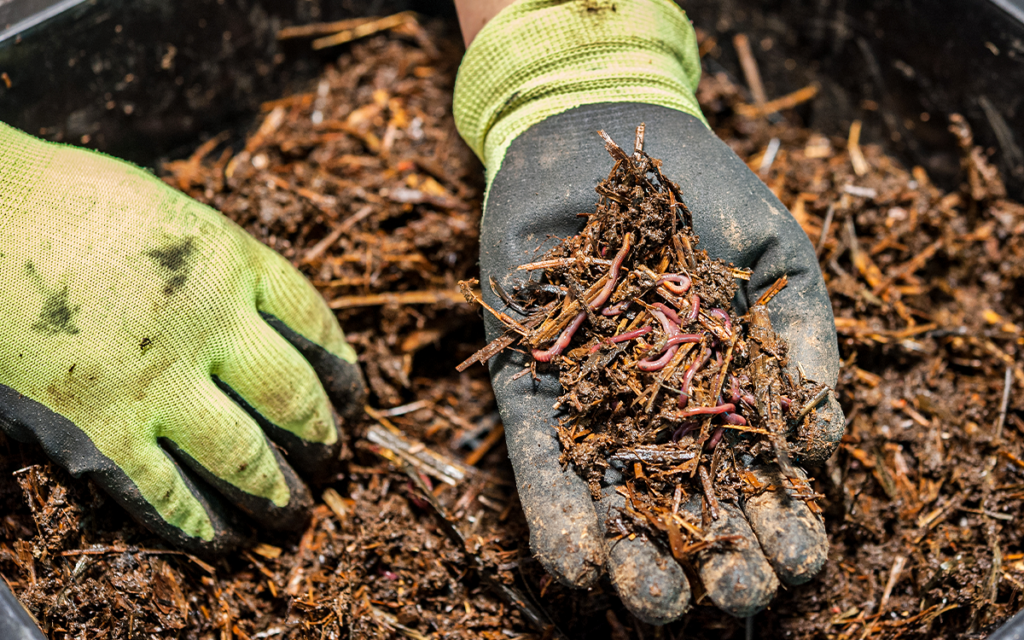
If you’re not squeamish and don’t mind getting your hands dirty, try vermicomposting. This cheap and easy composting method uses red worms to speed up the compost process. It’ll take about 3 months to create the finished compost, compared to years for some other methods.
You can purchase a worm composting bin at home improvement and garden centers, or make your own. Target sells a 6-gallon indoor worm composting bin for $84.49. A pound of red worms can cost about $15–30 from specialized websites and local breeders. The EPA offers a step-by-step process for creating and maintaining an indoor worm composting bin.
Compost pile collection

Once you’ve collected kitchen scraps—and don’t want to make finished compost yourself—you’ll need to give them away .
There are 3 ways to dispose of food waste for composting:
City curbside pickup
If your local waste-management company offers a curbside composting collection service, you can place food scraps in your green plastic compost bin for weekly pickup, at the same time as your trash and recycling. Your food scraps will be taken to a compost facility where they’ll be broken down organically and converted into nutrient-rich compost for gardening and agriculture.
Private compost pickup
If your local waste-management doesn’t offer curbside compost services, you can hire a local compost business to pick up food scraps weekly. Compost Now posts a list of providers by state.
Cost of collection varies. Compost Crew, a recycling center in Bethesda, Maryland, provides curbside collection starting at $32 per month, with a $20 introductory rate on Yelp for the first month of service. Included in the subscription is 2 bags of finished compost per year, which can be used as a fertilizer in garden beds, potted plants, or lawns.
“They make it incredibly easy for me to minimize what goes to the landfill,” explains Yelper Laura T. of Columbia, Maryland. “Just collect food scraps in the bucket they provide, put it out once a week, and they pick it up and provide a new liner.” (Note: Liners are optional, and sometimes provided by private compost collectors.)
Veteran Compost in the Washington, DC, area offers curbside collection starting at $25 per month. “We also produce organic compost, worm castings (the digested soil that earthworms leave behind), potting mix, and other soil products,” says Fritz Gottschalk, co-owner of the company, which hires veterans and their family members.
Drop-off services
If you’d prefer to drop off your food scraps directly, or you live in an area that doesn’t offer curbside collection, you can dump them at a local composting site. Your local farmer’s market may also maintain a compost bin for community dropoffs. You can find directories of dropoff locations and collection services online, such as this state-by-state listing.
Prepping waste for collection
Whether you pick up or drop off compost, how you deliver the waste is important. Pros recommend wrapping food scraps in paper bags, newspaper, or compostable bags before depositing them in the compost bin.
You can also line bins and break down compost piles with compostable bags, which are made from plant starch. Check with your waste-removal company first, since not all accept compostable bags. Natural Home sells a pack of 30 compostable compost-bin bags for $8.99 at Bed Bath & Beyond.
Eliminating the “ick” factor

Photo: Austin Bin Wash, Austin, Texas
Whether you’re composting indoors or outside, rotting food waste can breed germs, bacteria, and fungi. That’s why it’s important to clean your compost bins thoroughly.
Compost bin cleaners
Bin cleaning companies will come to your home to deep-clean compost (and trash) receptacles. Prices vary depending on your location and frequency of service.
Bin Cleaners of San Francisco, for example, will steam-clean bins with high-pressure water heated to 200 degrees. Prices for a house call range from $22 once a month to $85 for a one-time cleaning. In Texas, Austin Bin Wash charges $21.99 to clean 2 cans each month, and $30.99 for up to 2 cans cleaned every 2 months (6 washes per year).
“Our compost bin was nasty—food scraps stuck to the bottom, mysterious liquids, all kinds of gross things,” says Yelper Shelby S. of San Francisco. “There were a bunch of flies living in [the bins] and the garage where we keep [them]. Then, [they] started to appear inside our house-—yuck!! I found Bin Cleaners after a quick search and I’m SO happy I did.”
DIY cleaning
You can also purchase a power washer for $100–400 at Ace Hardware and other home-improvement centers. Renting a power washer is less expensive, at $40–100 a day, from companies such as Cresco Equipment Rentals in Danville, California.
Bins stay clean longer when the bottom is lined with a layer of yard trimmings. Avoid moldy, smelly, pest-attracting food waste by freezing food scraps and putting them into your bin the night before curbside pickup. Keeping scraps cold also slows the decomposition process.
Composting safety tips

To avoid transmission of compost fungi and bacteria, follow these precautions recommended by the International Association of Certified Home Inspectors (InterNACHI):
Wear protective gloves and footwear. Avoid making direct contact with compost. Always wear protective equipment when handling compost, or soils that have been treated with compost.
Wear a face mask. When stirring or tilling compost outdoors, make sure to cover your face and mouth, to avoid inhaling spores that can become airborne.
Wash hands after handling compost. This will prevent transporting bacteria to face and mouth.
Avoid airtight containers. Make sure your compost has proper ventilation. Without air, it can become combustible. Your indoor compost bin should also have air holes—otherwise, your compost will begin to smell.
Maintain your compost pile. Compost that uses worms to break down organic matter should be regularly rotated and aerated to avoid attracting pests and other predatory critters.
Find a compost pickup and dropoff service or compost bin cleaner in your area.
Find a good waste disposal service
Tell us about your composting project and we’ll connect you with trusted local pros.