7 outdoor landscape lighting ideas for your home
7 outdoor landscape lighting ideas for your home
Key takeaways
Landscape lights beautify a home and boosts its value
Pathway lighting increases safety at night
Solar LED landscape lights save energy and are easy to install
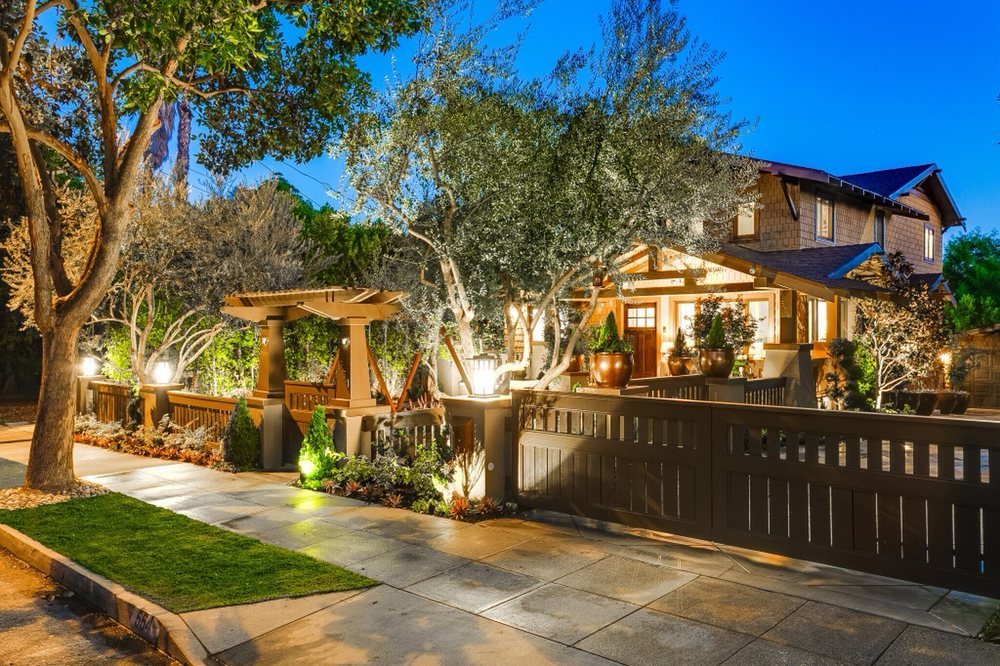
When the sun goes down, great outdoor landscape lighting can transform the look of your property. It highlights your home’s best outdoor features, illuminates the patio and yard for social gatherings, and provides safety and security for you and your family.
Strings of gleaming lights adorning trees, framing an entry door, spotlighting a patio—even lighting up a home basketball court—can turn your home from dark and dreary to light and dreamy, as many Yelpers have discovered.
“Neighbors, visitors, even strangers passing by, comment on the beauty of our gently lighted yard,” writes Yelper Carol T. of Lake Oswego, Oregon. “My house is [now] the jewel of the street,” boasts Yelper Patrick C. of San Diego after adding “more than 30 lights” to better showcase his property.
Because a beautifully lit home increases curb appeal, “outdoor lighting should be [at] the top of your [home improvement] list,” notes the website Realty Times. “It’s the first thing guests see from the street.”
Landscape lighting is not cheap, but it can make a home more appealing to buyers. A $5,000 lighting investment, for example, can boost resale price by $2,500, according to a 2018 report by the National Association of Realtors (NAR).
Learn about the best outdoor landscape lighting, and get great ideas for illuminating your home and yard—whether you do it yourself or hire a professional.
Maximizing curb appeal
Adding outdoor lighting is like staging your home from the outside. Every spotlight is designed to highlight a property’s natural assets, making it more attractive, livable and safe.
Light the entry and driveway
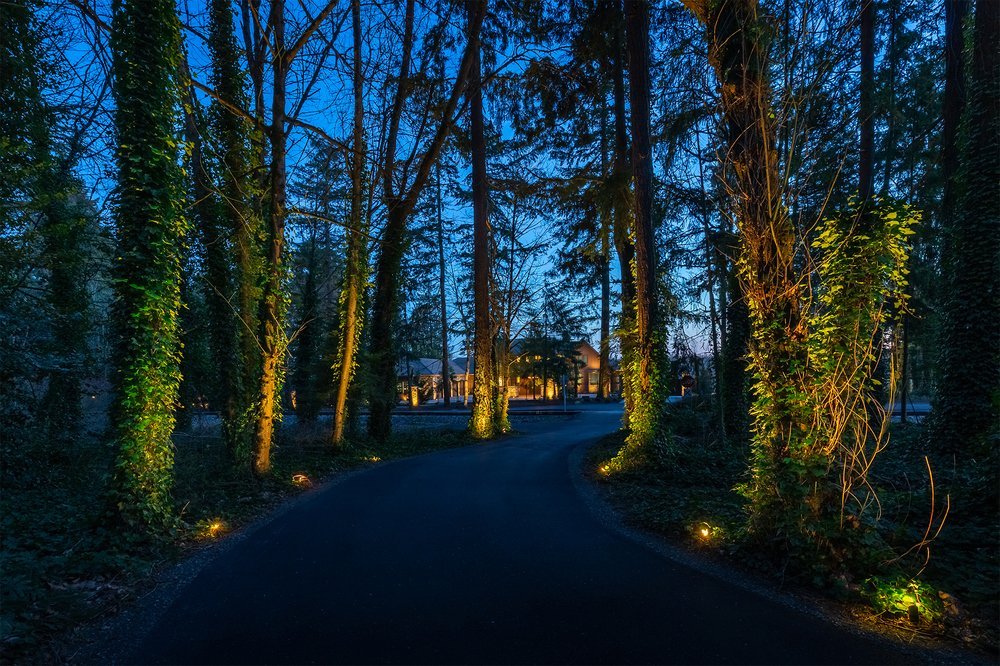
Framing a front door or garage with lights can add beauty and illumination to a home’s entryways. These fixtures, typically mounted on walls, are wired to the home’s standard-voltage (120-volt) electrical system and controlled by indoor switches.
Standard-voltage lighting is favored for wall lights because it’s both bright and reliable. Learn more about the differences between standard-voltage, low-voltage, and other lighting fixtures in Choosing the right outdoor landscape lighting.
For driveways, consider using ground-level fixtures that highlight the path without blinding the driver. Bollard lights—ground-mounted posts with lighting fixtures—are one popular choice. They’re available in either standard-voltage or more energy-efficient low-voltage.
Add architectural accent lighting
Accent lights call out interesting architectural features—such as your home’s roof line, window layouts, or front door. Landscape flood lights, spotlights, or LED landscape lighting can be mounted on the house or in-ground to create these effects. In most cases, standard 120-volt fixtures work best, because they can be plugged in or connected to available power inside the house.

Pro tip: When lighting a house, make sure brightness and placement is aesthetically balanced. A common mistake is lighting one area more brightly, giving the house an uneven look.
Spotlight trees and shrubs
Uplights and downlights can awaken trees and shrubbery at night, highlighting their grandeur and casting lively shadows throughout the yard. Here’s how to use each type:
Uplight for drama
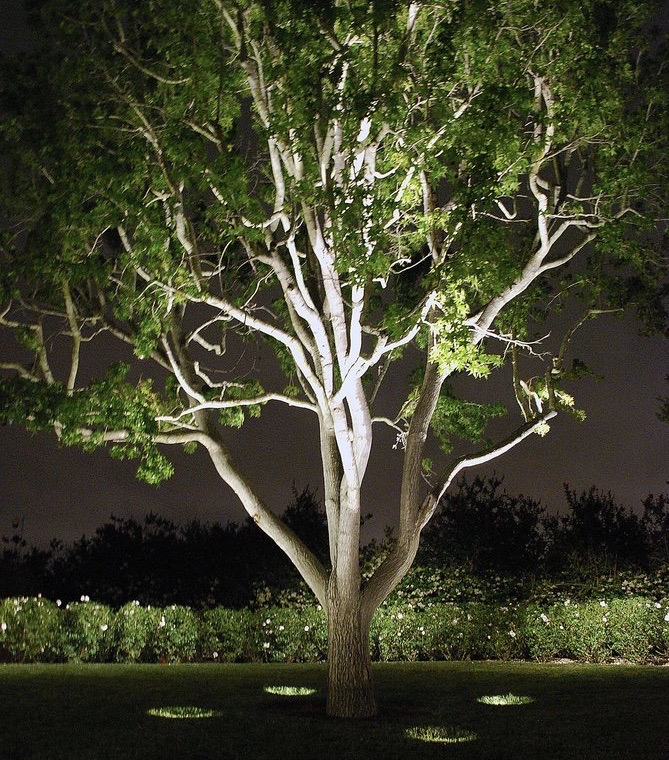
As the name suggests, uplights are mounted at ground level and set to shine upward. They’re typically in-ground well lights (with bases placed underground), or spotlights mounted on a spike.
Using landscape spotlights to uplight a dramatic tree is a great way to create stunning nightscapes, and highlight skyward-reaching branches. This ground-level setup is particularly DIY-friendly, because you don’t need to use a ladder or climb a tree.
Dense foliage is generally lit from the outside, directing the lights from a low angle. If the tree has an open structure, you can light inner branches from the ground directly below, to increase the dramatic effect.
Pro tip: Direct lights from two or three sides of a tree, so it can be enjoyed from all directions.
Downlight for shadows
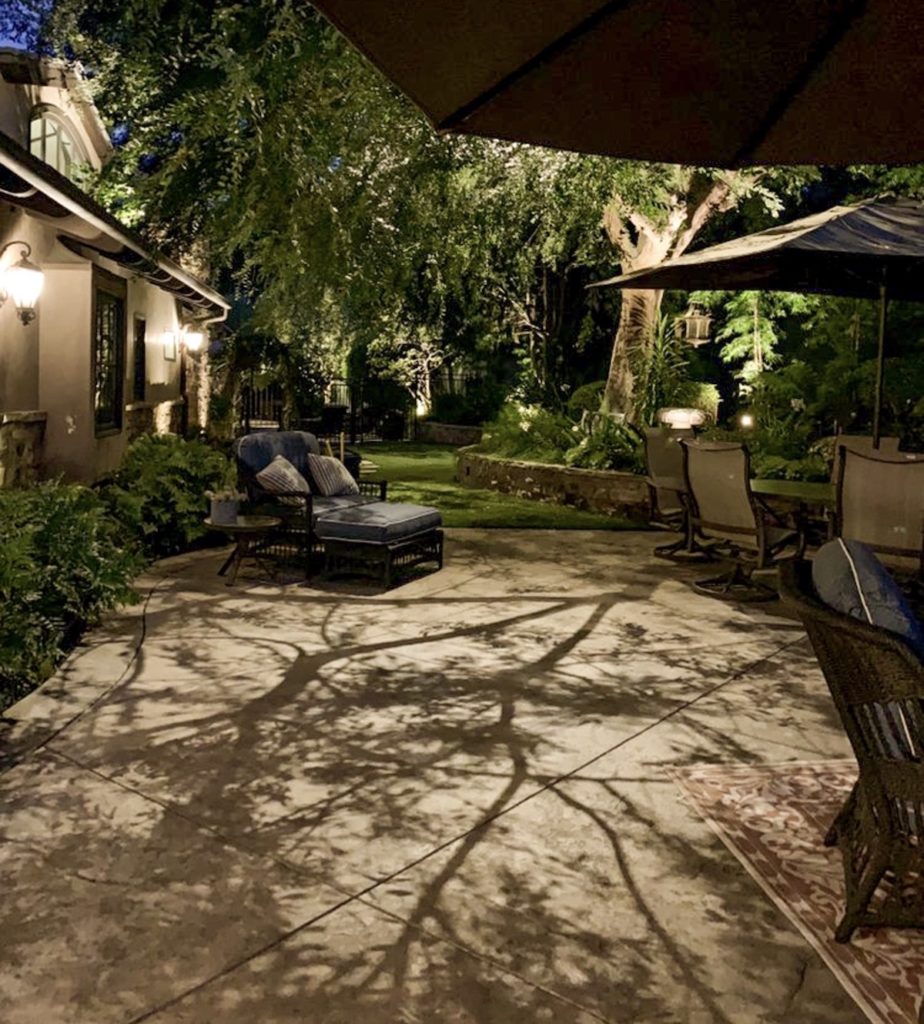
Downlighting creates a moonlight effect. It highlights the tops of branches, backlights the foliage, and casts dramatic shadows across the ground.
For downlighting, landscape spotlights or flood lights are placed high up in a tree. If you have a tall house, you can point lights at the tree from the home’s eaves.
The higher the light fixture, the more of the tree it will illuminate. Placing the light 20–30 feet high is usually best, because it covers much of the tree but isn’t too intense at ground level.
Planning and installing downlights, however, is a job for a pro. You’ll need someone who can safely work at heights, and knows how to plan the right fixtures and placements—including methods of attaching lights and cables so they don’t harm the tree.
Upgrade outdoor living
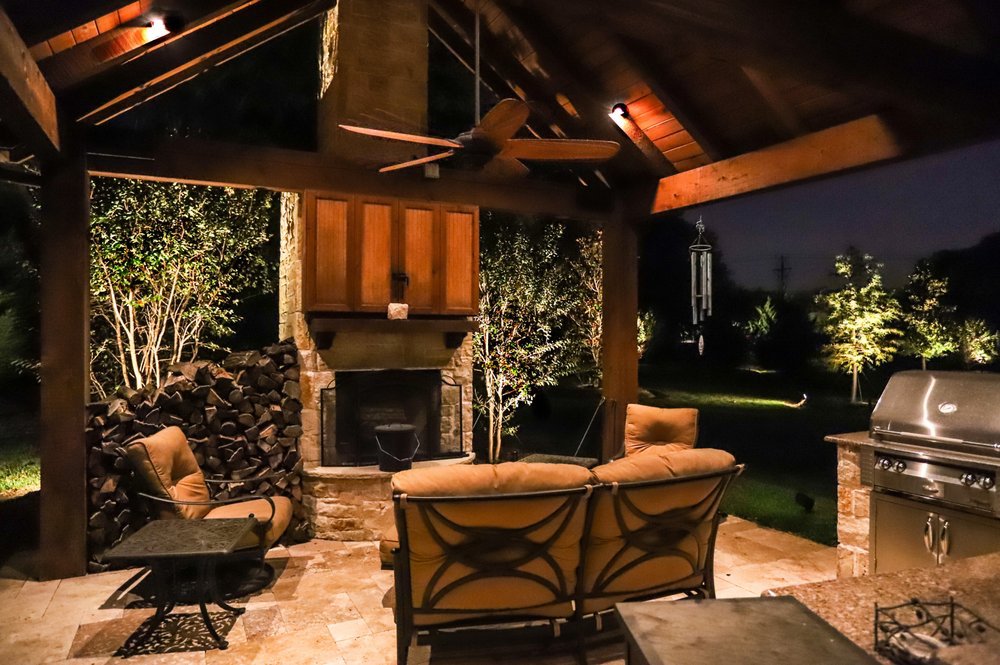
Landscape lighting can also enhance outdoor spaces for get-togethers and cookouts. When an outdoor kitchen or entertaining area is well lit, you can enjoy the company of friends and family long after the sun sets. Standard-voltage spotlights mounted atop a patio cover are often used to illuminate the area.
Light a yard or patio
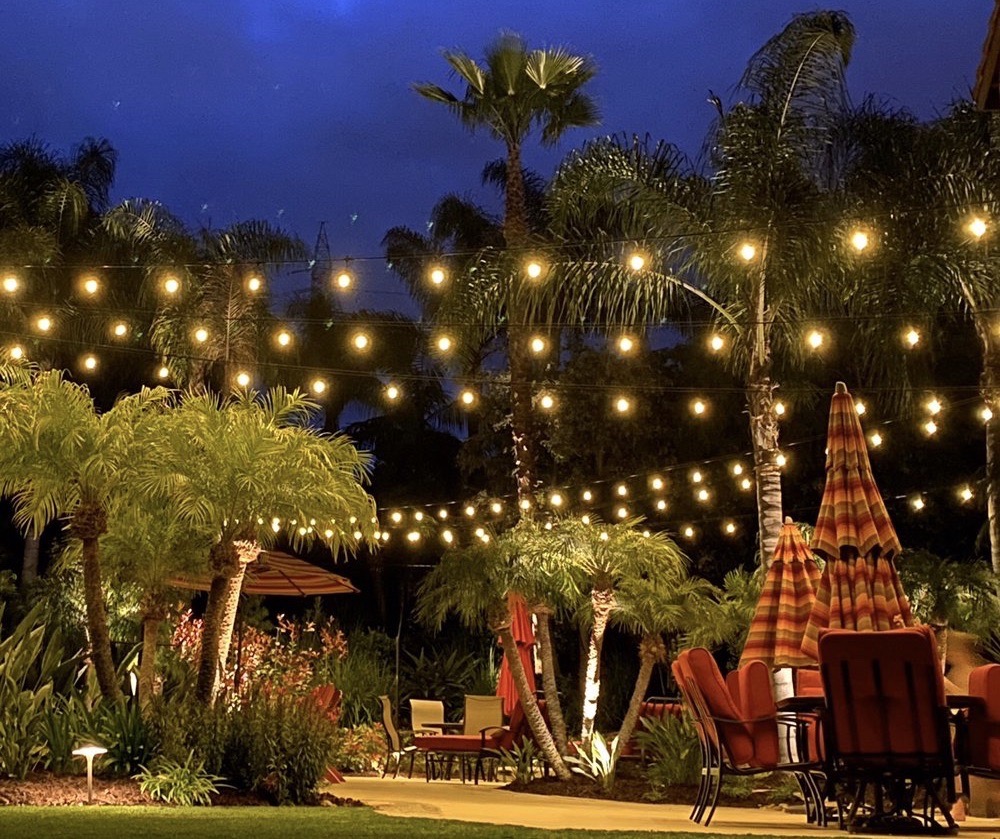
The best way to light a gazebo, pergola, or other patio structure? Add landscape spots or flood lighting.
Or sprinkle some evening magic on a patio or deck with inexpensive string lights. Similar to holiday lights, these small bulbs mounted along a wire, can be draped across the top of a patio, frame its perimeter, or dangle at the corners. The result is gentle illumination with the feel of an exotic resort.
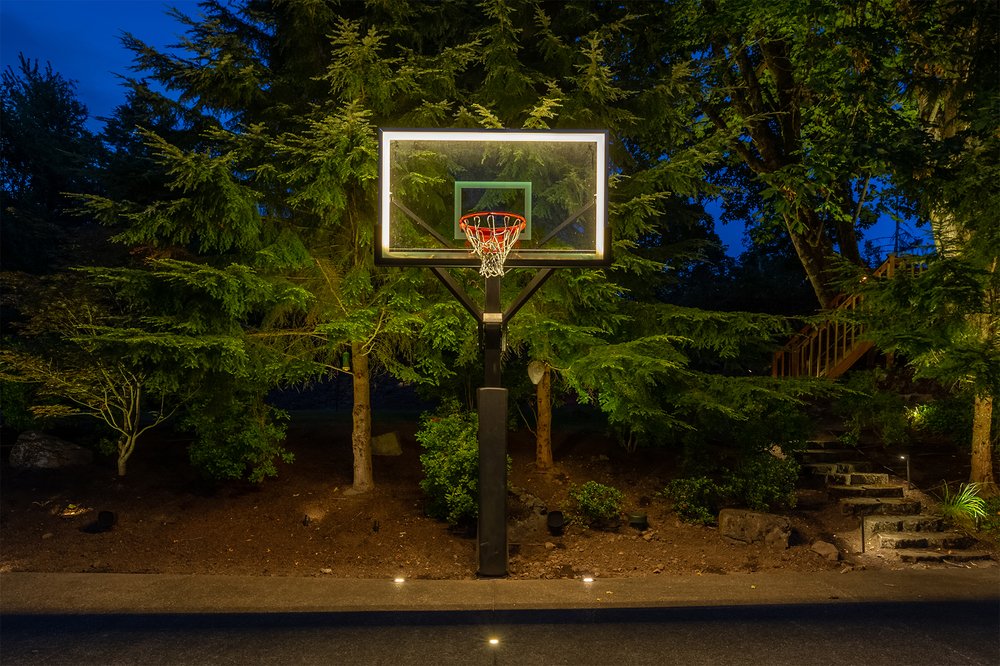
Outdoor lights can also brighten-up a home sports court or recreation area for playing after dark. What’s more fun than nighttime basketball?
Add beauty to a pool or fountain

If you have a swimming pool, it probably already has basic underwater lights. Make them more visually interesting by adding colored filters, or replacing them with LED color-changing pool lights. While you’re at it, enhance the entire pool area with landscape lighting.
If your yard has other water features, such as garden pools, fountains, or fish ponds, underwater lights can add a special glow at night. These kinds of lights are designed to be submerged. (Of course, you should never submerge a light that isn’t specifically made for use in water.)
Increase safety and security
A dark yard can be dangerous at night. Here’s how to use lighting to help keep you, your family, and visitors safe.
Light steps and pathways
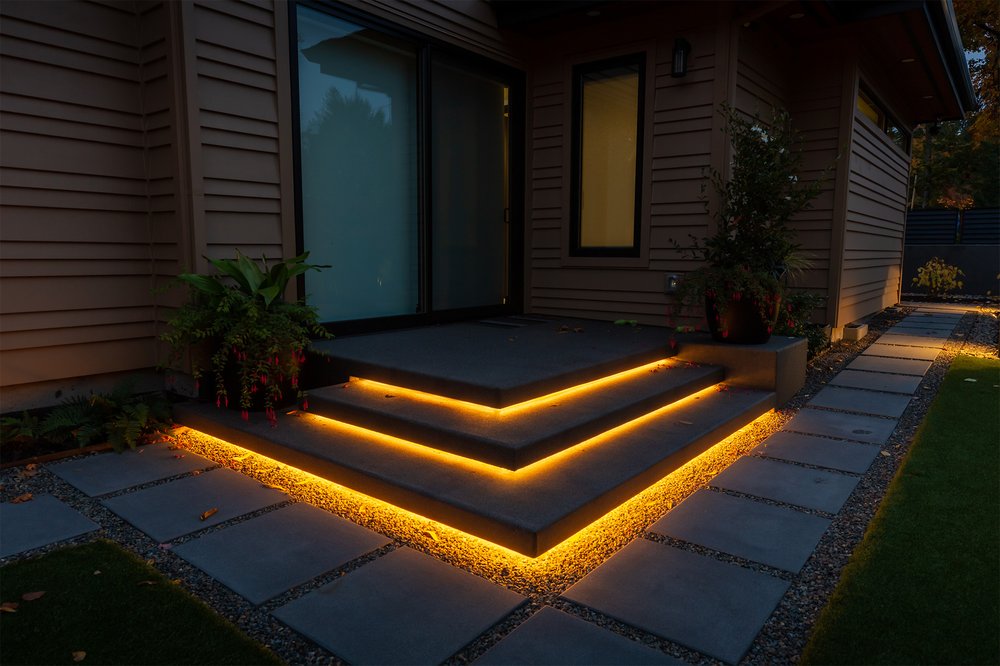
Landscape pathway lights aren’t just pretty—they illuminate paths and walkways so you can see where you’re going. Path lighting works best when it casts a gentle glow at your feet, lighting your way without producing a distracting glare.
Deck lights and step lights, as their names imply, cast lighting around a deck or stairs. Strip lights—long sealed strips with LED lights inside—can be embedded in concrete, mounted under ledges, or attached to walls or fencing. Just like landscape path lighting, they’re important safety features that make it easier to see where you’re walking.
Stop crime before it starts
The right lighting can also help prevent crime—thieves are less likely to choose a well-lit house where they might be spotted. Outdoor lights combined with a monitored security system, for example, is even better. Consider motion-controlled spotlights, which keep away unwanted guests without the expense (and waste) of powering lights all night long.
Security flood lights produce a bright, wide beam that can illuminate your driveway and entry—as well as large portions of your landscaping, if you need greater protection.
Installing outdoor lighting

You have two choices for developing an outdoor lighting system and installing landscape lights: 1) do it yourself, or 2) hire an outdoor landscape lighting professional.
DIY landscape lighting
For a simple lighting scheme, doing it yourself is fairly easy. You can buy a low-voltage landscape lighting kit that contains all the parts you need, often for as little as $80. It typically includes a 12-volt transformer-timer, 6 or 8 light fixtures, the electrical cable for hooking everything up, and the manufacturer’s installation instructions.
Higher-end kits feature multiple types of lighting in elegant styles. These kits can cost $700 or more.
You may also want to choose energy-efficient solar lights. These are even easier to install, because they don’t require any type of wiring—they get their energy from a tiny solar panel. Most come in the form of LED path lights, LED flood lights, LED spotlights and other LED bulbs. Of course, they require adequate sunlight to work properly.
How to hire an outdoor landscape lighting pro
Many landscaping companies are qualified to install outdoor lighting, as are most electrical contractors. But a landscape lighting specialist is more likely to have the skill set for proper installation and thoughtful lighting design. If you want someone who knows how to plan striking outdoor lighting effects, these experts are the ones to call.
Outdoor landscape lighting, however, is not cheap. Depending on the complexity and scale of your lighting, expect to spend $2,000–6,000 or more, according to the National Association of Realtors (NAR).
You can find landscape lighting professionals by searching Yelp for “outdoor lighting” or “landscape lighting.” When visiting these services, be sure to check user reviews and photos.
When interviewing potential candidates, ask whether they have lighting design credentials. Certification as a Certified Outdoor Lighting Designer (COLD) or or Certified Low-Voltage Lighting Technician (CLVLT) are strong signs of competence. Membership in the nonprofit International Landscape Lighting Institute (ILLI) is also a good indicator of professionalism. And ask for references from satisfied customers who can share photos of the finished project.
Find an outdoor landscape lighting pro in your area.
How outdoor landscape lighting pros have helped Yelpers
Lighting up front and backyards or other hardscapes is not just about stringing up pretty light bulbs. From illuminating pathways to adding dramatic flood lights in trees, landscape lighting pros can make your home safer and more enjoyable. Yelpers share their experiences.
Jewel of the neighborhood…
After making some cosmetic fixes to his home’s exterior, Patrick C. of San Diego discovered the missing element: outdoor lights, what he calls “the jewels of the house.” He hired Lightscape Designs,” a five-star business on Yelp, to add that finishing touch. “I had more than 30 lights put in,” he explained. “My house is, for sure, the jewel of the street.”
From dark to dreamy…
After Oregon Outdoor Lighting transformed Carol T. of Lake Oswego, Oregon’s home landscape from “dark and dreary to bright and dreamy,” she wrote. “I’m enchanted by the stunning silhouettes of our huge oak and rhododendron trees brought to life by the lights softly shining against the night sky. “[I now also have] a sense of safety and confidence with the added protection of lighted paths and porch areas.”
Elegant lighting for less…
For years, Evan B, Cambridge, MA avoided landscape lighting, thinking it would cost too much money. After getting bids starting at $5,000, he found Southern Lighting Designs on Yelp, which did the job for $1,500. They were “creative in finding the most cost-effective strategies,” he explained, paying only for the “elegant brushed bronze fixtures… which included installation…and a high-tech solution for “real-time scene selection and dimming. The downside? “It might annoy your neighbors now that your house looks so much better than theirs,” he said.
Find a landscape lighting expert
Tell us about your landscape lighting project and we’ll connect you with trusted local pros.