10 types of kitchen countertops for every budget
10 types of kitchen countertops for every budget
Key takeaways
It’s possible get the stylish granite look on a $1,500 (and up) laminate budget
Quartz and other non-porous surfaces are best for sanitary food prep
With regular care, soapstone countertops can last 100 years
Homeowners know nothing lasts forever. Air-conditioning units have a lifespan of 10-15 years. Ranges, 12 years. Washing machines, a decade. Owning a home means replacing its contents when they—inevitably—break down.
Although countertops don’t come with expiration dates, you’ll know when they’re past their prime. Those 1970s-era avocado laminate countertops, for instance, now clash with your new stainless steel appliances. Or unsightly stains, scorch marks, and water damage mar once-elegant marble countertops.
Outdated or blemished kitchen countertops not only detract from the room’s overall look, they can also affect the value of your home. But remodeling or replacing a damaged countertop is not cheap.
The cost of new countertops starts at $1,500, including installation. And that’s just for plastic laminate, which isn’t everyone’s favorite material or look. Plus, if you choose a more current style, you may be updating those countertops again when you sell your home.
Remember, trends come and go. Don’t just think about what looks good now. Think about a countertop you can live with 10 years from now, especially if you’re on a budget. You don’t want buyer’s remorse, so choose wisely!
Kitchen countertop materials

Countertops not only provide a stable surface for cutting boards, groceries, and meal preparation, they also contribute to a kitchen’s look and feel. The material you choose—whether granite, marble, quartz, concrete, butcher block, soapstone, stainless steel, laminate, tile, or solid surface—will play a major role in the overall aesthetic.
You’ll pay anywhere from $1,000 for a basic surface to $8,000 or more for high-end materials. General maintenance is the same for all countertop types: Simply wipe down with warm sudsy water and a microfiber cloth.
Related: Learn which kitchen countertop types are most affordable…and get more budget kitchen remodel ideas.
Here’s what you need to know about each type of countertop material:
Granite countertops
Genuine granite slabs, cut from natural stone blocks, are a longtime favorite. It’s hard to match the beauty and appeal of authentic, quarried rock. Especially when that rock is stain-resistant, heat-resistant, and almost scratch-resistant.
Granite is porous, however, and a countertop’s protective seal doesn’t last forever, so liquids can seep into the stone and weaken it. Even worse, dirt, bacteria, and fungi can collect and spread on unsealed stone.
That’s why it’s important to reseal the surface every year. Resealing—with a spray or liquid formula—doesn’t prevent stains, but does allow time to clean up a mess before it can penetrate the seal.
You can purchase granite as a slab, in modular units, or as tiles. Here’s how they differ:
Slab granite
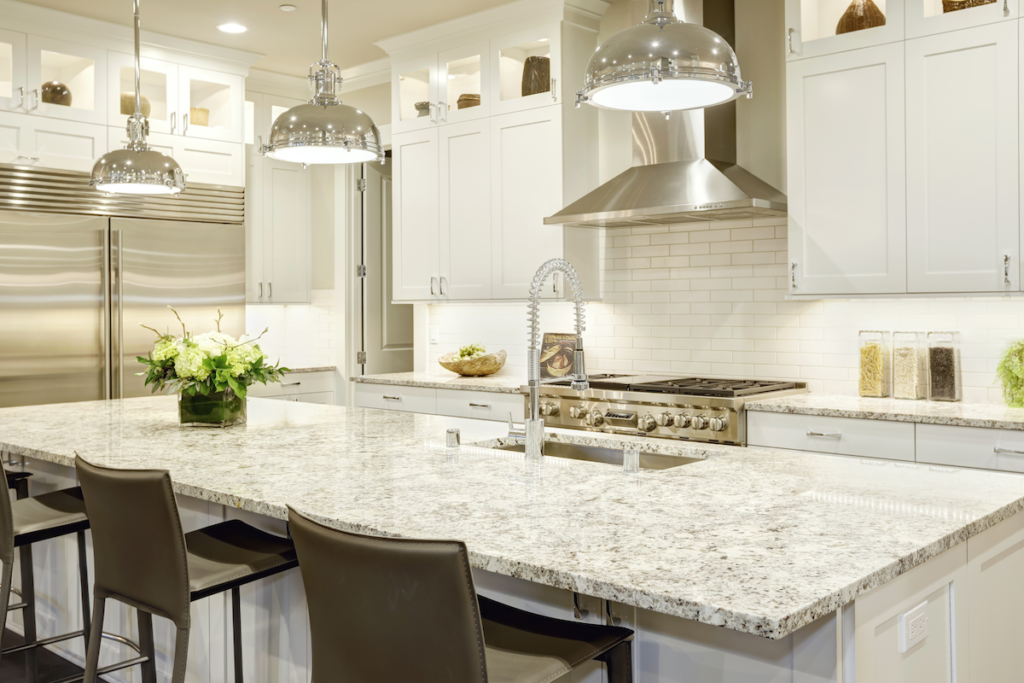
Most homeowners prefer slab countertops for their sleek, seamless look. Contractors cut the slab to size, then carve out holes for the faucet and sink. At $80–150 per square foot with installation, this is the priciest granite top you can buy.
Modular granite
Dreaming of a granite countertop but can’t afford the price? Modular, DIY granite kits come with thin, 1×2-foot mini-slabs that are lighter-weight and less expensive than slab. The downside: When assembled, they create a seamed surface that’s often less desirable to homeowners.
If, however, you don’t mind those interruptions, you can have granite for a fraction of solid-slab price. A 6-foot-long modular top with 5 seams, for example, costs just $25–40 per square foot—and no added labor charges.
You’ll need a drill, level, granite edge saw, straight edge, and intermediate DIY skills. While laying modules on mortar is fairly easy, cutting them to fit your space demands more experience.
Granite tiles
Granite tiles are another lower-cost option. As with modular, you’ll be giving up the solid slab look but will gain a stylish granite top. Granite tiles are about half the price of full-slab granite, at $50–75 per square foot, including installation.
The 12×12-inch tiles are held in place with grout—which makes them less appealing to homeowners. An intermediate DIYer can install them using the same tools as modular granite, with some extra steps. You’ll have to install a plywood top and backer board before applying thinset (an adhesive made of cement, water, and sand), tiles, and grout. You’ll also need a wet saw to cut tiles for trim work.
With regular care, any type of granite countertop could last 100 years.
Marble countertops

These natural stone countertops are made from metamorphic rock with veining formed over millions of years. They’re stunning, timeless, and high-end, especially when paired with a marble backsplash.
But marble is one high-maintenance beauty. Its porous surface stains easily and should be resealed every six months.
Marble is also softer than granite, which makes it prone to scratching. And, at $50–190 per square foot (with another $3,000 for installation), marble is expensive compared to other countertop materials.
On the upside, marble could last a century with proper maintenance. Avoid using common cleaning products on marble. Bleach, vinegar, or window cleaner will dull the stone.
Quartz countertops
People love quartz for its marble look without the high maintenance. Made from quartz dust and chips, stones, resin, and pigment, this engineered stone surface can be tinted any hue and comes in a wide range of colors. Silestone is the leading manufacturer of quartz countertops.
Quartz is as expensive as marble; installation adds another $2,000–4,000. But because resins make quartz nonporous, the countertop never has to be sealed. With proper maintenance, quartz could last a lifetime.
On the downside, prolonged exposure to direct sunlight causes quartz to fade. If you like lots of sunshine in the kitchen, choose light-colored quartz or a different surface.
Concrete countertops
Concrete looks great in rustic, industrial, and modern kitchens. The downside: It’s porous, susceptible to scratches, and requires sealing—and regular resealing—to prevent bacterial growth.
Concrete is not cheap, either. It costs $70–130 per square foot, and another $60 per hour for installation. A basic concrete countertop comes with straight edges, and holes for the faucet and sink. High-end options include custom colors, edges, and inlays.
YouTube videos showing how to pour concrete countertops have fueled this design material’s popularity, but it’s not a job for DIY rookies. Concrete is heavy, and precise cutting is necessary to make sure the sink fits. For best results, hire a concrete countertop contractor.
With regular maintenance, a concrete surface should last a couple of decades or more.
To remove concrete countertop stains:
Make a paste with baking soda and water.
Cover the stain with paste and a wet paper towel.
Wait a few minutes before wiping away the paste.
Wiping should also remove the stain.
Repeat, as needed.
Butcher block countertops

Wood countertops add warmth and come in maple, teak, and walnut.
While beautiful, they’re also porous. The US Food and Drug Administration (FDA) recommends finishing them once a month with food-safe mineral oil when used as a butcher block with raw meat. Otherwise, apply lacquer or urethane sealer every six months to keep wood countertops looking their best.
Despite their high maintenance, wood is more forgiving than other surfaces. Scorches or stains can easily be sanded down and refinished
But wood countertops are another costly option. Expect to pay $75–120 per square foot for a basic butcher block, and another $600 for labor. Customized features—such as edge-grain, end-grain, or flat-grain construction—along with desirable countertop corners, curves, and finish, will cost $200 per square foot.
On the upside, wood countertops will last 20 years or more with proper daily care. To clean:
Mix water and mild dishwashing liquid and apply the solution with a sponge.
Blot stains immediately to prevent them from causing permanent damage.
For tougher spots, sprinkle salt on the stain and scrub it with a half-cut lemon.The acidic lemon juices, along with the gritty texture of the salt, will remove most stains.
Working with raw meat on a butcher block countertop? Mix a tablespoon of bleach with a gallon of warm water to kill bacteria. Spray solution on the countertop and wipe with a clean cloth.
Soapstone countertops
Sculptors have enjoyed working with soapstone for centuries. This metamorphic rock—made of talc and other minerals—is soft, slippery, and easy to carve. Colors are limited to muted grays with blue or green hues, but white veining adds depth and interest.
Soapstone is nonporous and heat-resistant. But it darkens with age and develops scratches and dings from use. The resulting patina frustrates some homeowners and thrills others, who expect its “lived-in” look.
It’s also easy to chip or scratch, so be careful! Just dropping a knife on this countertop could cause permanent damage. And at $70–120 per square foot (installation adds another $700), soapstone is pricey to repair or replace.
On the upside, soapstone will last 100 years and continue to look great with proper care. Applying mineral oil will give it a dark finish, revealing fewer flaws.
Stainless steel countertops

Commercial kitchens need countertops that withstand hot pots and pans. That’s why professional chefs prefer stainless steel. It resists heat and rust, and takes daily abuse. The surface is nonporous and easy to clean; just wipe it down with a damp rag or, for stubborn stains, a mixture of baking soda and water.
Gleaming stainless-steel countertops are a popular choice among homeowners who want contemporary surfaces that can take a beating. Stainless steel’s reflectiveness makes the kitchen look bigger, another benefit for small spaces.
Best of all, these countertops are quite versatile. They come in antique matte, brushed, hammered, and mirrored finishes, and look great in modern, industrial, or even rustic, kitchens.
Stainless steel comes at a premium—about $200 per square foot, including installation. And it’s not scratch-resistant. But treated with care, these countertops could last 30 years.
Laminate countertops
In the 1950s, Formica introduced plastic laminate countertops—made from particle board, fabric or paper and resin—as a stylish, affordable alternative to wood and stone. Improvements and efficiencies in stonecutting technology, however, eventually made granite accessible to more homeowners and laminate fell out of favor.
Long regarded as cheap-looking and tacky, laminate has made a comeback. The latest printing technology creates laminates that look almost like granite, metal, and quartz.
Still, laminates burn easily, so don’t place hot pans on them. They’re also vulnerable to chipping. And water damage can cause delamination, which often requires replacement of the entire countertop.
Laminate countertops are gently priced at $15–35 per square foot, without installation. Not bad for a material that lasts 10 to 20 years! Their light weight makes installation DIY-friendly, but you can hire a handyperson to do the job for about $30 an hour.
To remove stains, make a paste from baking soda and water, let it set for a few minutes and gently wipe with a clean cloth.
Tile countertops

Tiles come in a variety of colors, shapes, and materials, providing endless design possibilities. Go bold for a contemporary look, or stick with neutrals for timeless or shabby-chic settings.
Hand-painted ceramic tiles with intricate details add a custom look; translucent glass tiles glisten like gems; and stone tiles bring nature’s beauty indoors.
Ceramic or glass tile, professionally installed, may set you back $25–30 per square foot. For natural stone, expect to pay $60 per square foot.
Tiles are mostly nonporous and can last two or three decades if resealed every few years. The downside: They’re installed with grout, which can get grubby and permanently stained from cooking and food prep.
To clean grout, grab an old toothbrush and scrub it with a mild bleach solution, then apply a commercial grout sealer. Clean the tiles themselves with a microfiber cloth and a mixture of white vinegar and water.
Solid surface countertops
Solid surface is a material made from minerals and acrylic resins that resembles stone. It’s used in bathtubs, sinks, and kitchen countertops.
Corian manufactured the first solid surface countertops. Designers love their invisible, welded seams. They’re also low-maintenance, nonporous, and don’t need resealing.
On the downside, knives and sharp utensils can scratch solid surface countertops, and you should always place hot pans on trivets to prevent damage. With proper care, they can last for a few decades.
Solid surface countertops cost $50–120 per square foot, with installation; the material’s price varies by manufacturer, color, and pattern.
Environmentally friendly options

Looking for eco-friendly kitchen countertops? There are numerous options that fit almost every budget.
Recycled glass in a concrete base keeps glass out of the landfill. It’s nonporous and ranges from $50–55 per square foot, excluding installation. This option isn’t for everybody. It can look stunning to some people—or like thousands of shards of glass embedded in a countertop to others.
Paper composite in a formaldehyde-free resin base costs about $30 per square foot, excluding installation. It’s made from post-consumer paper products that are pressed and baked at high temperatures to form nonporous slabs. The result looks and feels like soft stone, but surface seams are tighter and cleaner than those of stone slabs.
Bamboo, a fast-growing renewable resource, costs just $23 per square foot, excluding installation. It’s not heat-resistant, but it’s forgiving when it comes to scratches—just buff or sand them out. Don’t use this as a butcher block, though; it’ll weaken over time.
Kitchen countertop installation: DIY or hire a pro?
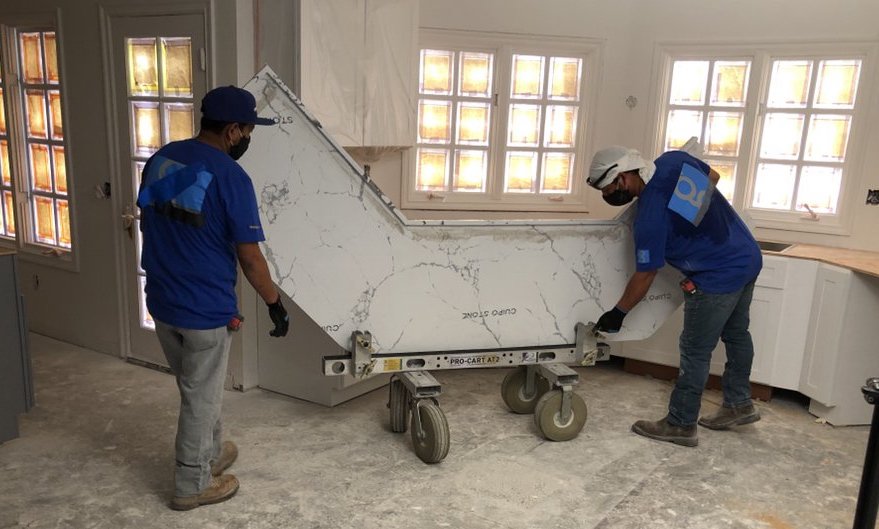
Retail prices for kitchen countertops don’t tell the whole story. Every home has unique needs that affect the final price. Plus, installation can cost as much as the countertop itself.
DIY trade-offs
You’ll save on installation costs—which can account for almost half the total tab—by doing the job yourself. What you save in labor, however, you’ll more than make up for in time and frustration— following online tutorials, and all the miscalculations that go with it.
You’ll also pay for surface materials, buying or renting tools to cut out holes for appliances, and grouting, sealing, and staining the countertop.
Benefits of a hiring a kitchen countertop pro
Hiring a pro adds to the project’s overall costs, but can save time, reduce stress, and ultimately deliver a better result. Electrical or gas connections should always be handled by a professional electrician or HVAC contractor.
When requesting a quote from a contractor, have a list of everything you’ll need, size- and style-wise, for the project. Make sure they know about any plumbing limitations, awkward spaces, electrical-outlet considerations, or special cuts they’ll need to make. Providing complete project specs will help the pro give you the most accurate estimate.
Other cost considerations include the countertop’s edges and corner treatments; removing and reinstalling the sink; disconnecting and reconnecting the sink’s plumbing; and discarding old countertops and project materials.
Find a kitchen countertop contractor
Tell us about your kitchen project and we’ll connect you with trusted local pros